Tianxing manufactures custom down jackets for outdoor brands, private-label apparel companies, wholesalers, distributors and workwear or winterwear programs.
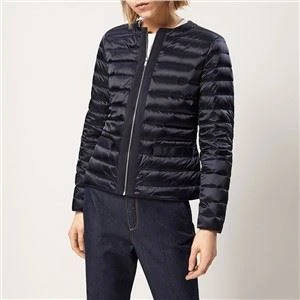
Lightweight Down Jackets:For travel apparel, transitional seasons, layering systems, and packable products. Priorities: low weight, compressibility, and warmth-to-weight ratio.
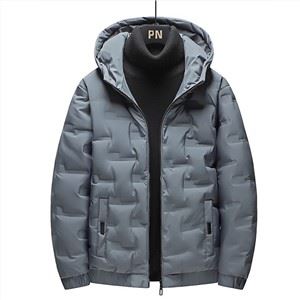
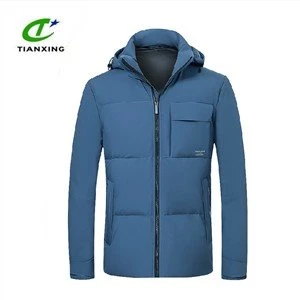
Hooded Down Jackets:For colder climates requiring head/neck protection. Options: fixed or detachable hood, adjustable hood, hood insulation, high collar, drawcord, and storm flap.
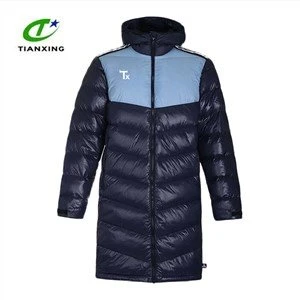
Long Down Jackets:For increased body coverage and colder-weather applications. Consider: length, down distribution, lower-body insulation, weight, mobility, zipper, and hood design.
Short Down Jackets:For lifestyle, outdoor, and urban winter collections where mobility and styling matter.
Down Jackets for Kids:Focus on size grading, weight, warmth, construction safety, trims, labeling, and destination-market regulations.
Fashion Down Jackets:Down insulation in fashion silhouettes: oversized, cropped, shiny-shell, long coats, or quilted fashion jackets. Outer fabric, quilting, silhouette, and hardware developed per collection direction.

One of the most common mistakes when comparing down jacket suppliers is comparing fill power alone. A jacket's warmth and performance depend on several variables working together:
Fill Power:Measures the lofting ability of down. Higher fill power offers a better warmth-to-weight ratio, but does not automatically mean one jacket is warmer than another. High fill power with very low fill weight may provide less total insulation than lower fill power with substantially more down.
Fill Weight:The actual amount of down used in the garment. Directly affects overall warmth, garment weight, cost, and packability.
Down-to-Feather Ratio:Affects insulation efficiency, hand feel, and product positioning. Common commercial specs: 80/20, 90/10, 95/5. Select by target performance and price.
Down Type:Duck down, goose down, white duck down, white goose down, or other approved insulation materials.
The way down is distributed inside the jacket directly affects insulation performance and appearance.
Quilted Construction:
Keeps insulation in defined sections. Common patterns: horizontal, diamond, vertical, or custom geometry.
Baffle Construction:
Reduces cold spots and improves insulation distribution. Key factors: baffle width, height, down distribution, and stitch-through vs. other methods.
Down Distribution:
Uneven fill creates cold areas. We control fill quantity, filling process, chamber distribution, seam construction, and final garment appearance to ensure consistent insulation.
The shell fabric affects more than appearance—it influences garment weight, down leakage resistance, abrasion resistance, wind protection, water repellency, hand feel, packability, and retail appearance.
Common Fabric Options
|
Fabric |
Typical Advantages |
Suitable Programs |
|
Nylon |
Lightweight and durable |
Outdoor & technical |
|
Polyester |
Versatile and cost-effective |
Commercial winterwear |
|
Ripstop Nylon |
Improved tear resistance |
Outdoor applications |
|
Recycled Polyester |
Supports recycled-material programs |
Sustainable collections |
|
Shiny Polyester / Nylon |
Fashion appearance |
Lifestyle & fashion |
|
Matte Technical Fabric |
Premium technical appearance |
Outdoor brands |
OEM/ODM buyers can customize major product elements:
Insulation:
Down type, down-to-feather ratio, fill power, fill weight, or synthetic alternatives.
Shell & Lining:
Nylon, polyester, ripstop, recycled materials, shiny/matte finishes, or custom lining.
Construction:
Quilting pattern, baffle construction, hood, collar, cuffs, hem, pocket configuration, and inner pockets.
Hardware:
Zippers, snap buttons, cord locks, pullers, and custom zipper pulls.
Branding:
Embroidery, heat transfer, printed logo, woven label, care label, hangtag, and custom packaging.
OEM Size Chart:
If you have a technical spec, we develop garments per chest, shoulder, sleeve, back length, hem, collar, hood, and pocket dimensions. For down jackets, measurements should be reviewed together with fill weight and garment thickness to ensure final fit matches the approved sample.
Down leakage is one of the common quality concerns in down apparel. It can be affected by shell fabric construction, fabric density, needle size, stitching, seam construction, down/feather characteristics, and the filling process.
A jacket should not be evaluated only by its appearance immediately after production. Buyers should also consider feather/down migration, seam leakage, fabric down-proof performance, washing performance, and repeated-use behavior.
Recommended Approach:For new projects, confirm shell fabric and construction during sample development and establish acceptable leakage criteria before bulk production—reducing the risk of discovering unacceptable down leakage only after delivery.

For down products, sampling is particularly important because final performance depends on both material and construction.
Product Brief:
Provide reference image, tech pack, target market, quantity, target price, and required warmth level.
Material Selection:
Confirm down specification, fill weight, shell fabric, lining, and hardware.
Prototype:
Develop initial sample based on agreed construction.
Fit & Insulation Review:
Check size, fit, garment weight, down distribution, quilting, hood, pockets, and overall appearance.
Modification:
Adjust pattern, fabric, fill weight, or construction if needed.
PPS Approval:
Approved Pre-Production Sample becomes the production reference.
Bulk Production:
Mass production follows approved specifications.
Final Inspection:
Finished products inspected before packaging and shipment.
Down jackets can involve specific material, labeling, and animal-origin requirements depending on the destination market. Before production, buyers should confirm applicable requirements for:
• Fiber composition
• Down composition
• Down/feather labeling
• Country-of-origin labeling
• Care instructions
• Chemical restrictions
• Product testing
• Recycled-content claims
• Animal-origin documentation
For recycled fabric, other certified materials, and down products that require traceability, the necessary certifications, relevant standards and documents should be confirmed before material procurement. We will strictly produce according to your requirements and provide the corresponding materials.